

Boycotts don’t work anymore
Stop pretending this is organizing

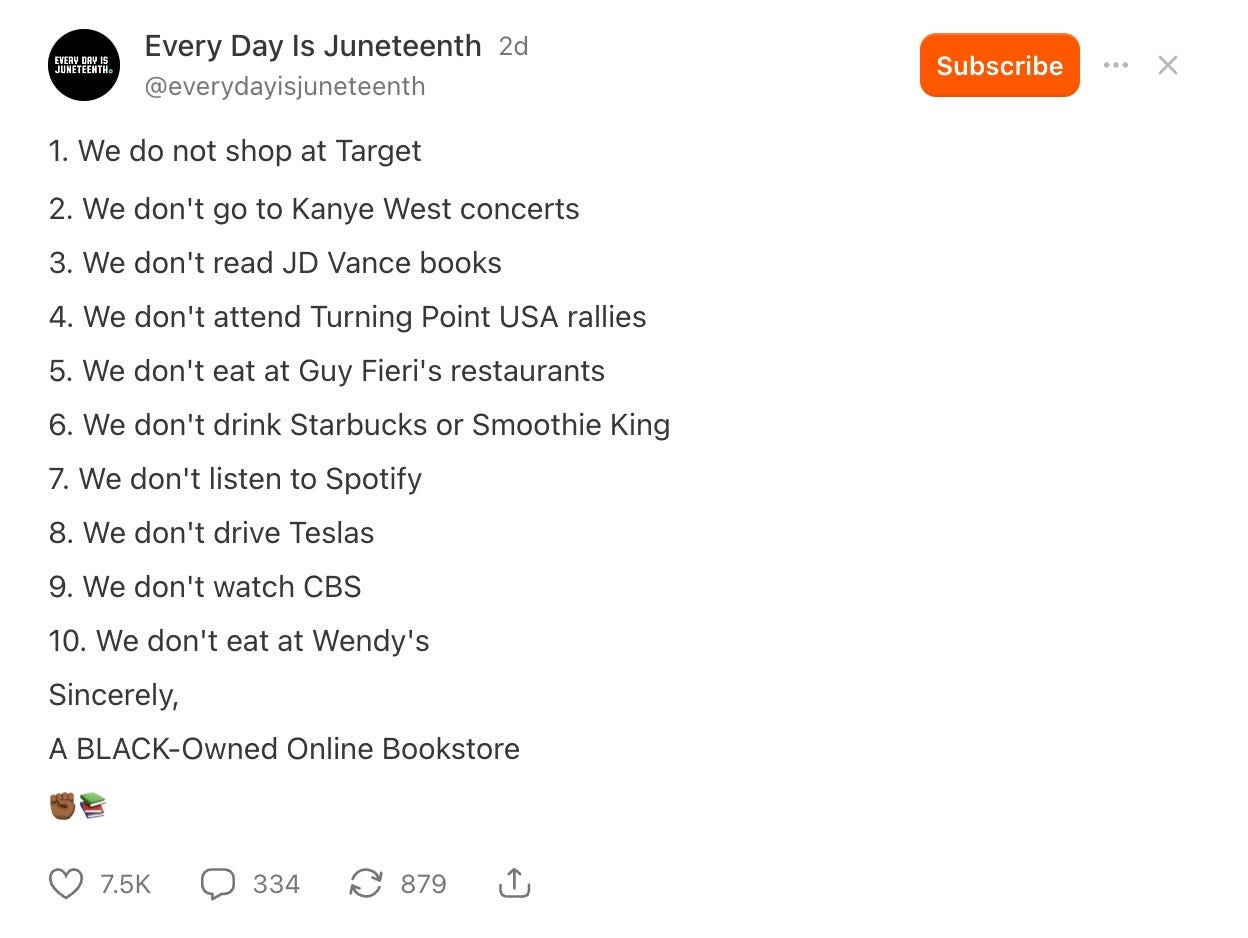
For some people, virtue signaling is a full-time job. Just look at this recent list of “boycotts.” Do you even know why some of the brands are on the list?
Suggesting that the path to liberation is paved with not eating a Frosty is a special kind of stupid. It’s elitist, it’s condescending, and it’s a distraction.
Now, some of you might be surprised that I’d say that. Didn’t I kick off the campaign to highlight the anti-LGBTQ policies of the Salvation Army that still has people posting their annual “ignore the red kettles” memes every holiday season? Didn’t I scream bloody murder about Bolthouse Farms’ ties to Christian extremists and fend off Rockstar Energy drinks high-priced lawyers after my site exposed them? Weren’t those boycotts?
The Salvation Army decided that homosexuality isn’t a sin now and ended policies that discriminated against gay couples and transgender people. Rockstar donated thousands of dollars to LGBTQ charities. Bolthouse Farms extended benefits to same-sex partners and diversified its supply chain while disavowing the founder’s support of anti-LGBTQ causes.
Weren’t those efforts successful? Yes.
Were they boycotts? No. They were PR campaigns.
How boycotts actually work
Sure, donations to the Salvation Army’s red kettles went down. Were queer people responsible, or did the shift to credit and debit cards and the fact that most people don’t carry cash have more to do with it? Do you really think that a couple of months of LGBTQ people not buying energy drinks or carrot juice brought the companies to their knees, begging to be profitable again?
That’s just not how the modern economy works.
With a boycott, success is measured in how much you depress a company’s sales. That’s why that asinine holier-than-thou post lists things you buy. (Except for attending Turning Point USA rallies, but, JFC, what liberals are going to those anyhow? That’s like promising I’m not going to buy a yacht tomorrow; it was never going to happen!)
What actually works is a lot simpler and easier to pull off. You give their name and product a negative connotation with the general public. You depress their brand equity. The damage to their reputation will bring a company to the bargaining table faster than promises to cut profits immediately.
The math of reputational value
Not eating at Chick-Fil-A is still a badge of honor for some queer folks. Do you know how that started? One franchise donated some sandwiches to a church group, and a local blogger sent an angry email to a group of activists and wrote a post that went viral. By the time most people heard about it, the origin story had already been cleaned up into something more heroic about corporate donations to anti-LGBTQ causes. Whammo! Outrage!
When we “boycotted” Chick-Fil-A, the other side threw an “Appreciation Day.” Sales actually went up, and it helped their bottom line. But when we made Chick-Fil-A synonymous with hate in a way that made airport authorities and city councils block their leases, that is when the C-suite started sweating. They don’t care about your combo meal; they care about their 30-year growth plan.
Chick-Fil-A suffered from a loss of reputational value, but I had to go look up why Wendy’s is even on the no-no list.
Wendy’s is there because they won’t pay an extra penny per pound for tomatoes to ensure farmworkers aren’t treated like medieval serfs. It’s a noble cause. But instead of telling you that, the graphic just tells you “Wendy’s Bad.” It’s a secret handshake for the in-crowd rather than a tool for change.
I didn’t need a million people to stop buying an energy drink; I just needed the company to realize that the headlines were costing them more in brand value than the cost of a few diversity initiatives and some big checks to charity. Have you seen any headlines about Wendy’s?
The Salvation Army still struggles to get folks to realize they made the fastest turnaround on LGBTQ issues of any religious denomination in history, but Rockstar had better-paid damage-control consultants to help them mitigate the bad publicity. And honestly, I don’t care what people think of them now. I got what I wanted.
Does it matter that they all continue to rake in cash? Will skipping the Baconator grind capitalism to a halt and stop the rise of authoritarianism? Chick-Fil-A sales didn’t crumble, but they did stop giving so generously to specifically anti-LGBTQ causes. Which was more important?
If you actually want to win
Stop calling everything a boycott. It isn’t. A boycott is a financial audit; a pressure campaign is a character assassination. One is hard to prove; the other is impossible to ignore.
A boycott is a blunt instrument. You’re trying to hit a company’s revenue and force change through lost sales. That only works if it’s massive, sustained, and disciplined. A random list of places you’re not shopping this week doesn’t even come close.
What actually works is pressure. You pick a target. You say exactly what you want. Then you make their name synonymous with the problem until it’s cheaper for them to fix it than to keep explaining it.
That’s what we did. That’s why it worked.
When you “boycott” 20 companies at once, you’re boycotting nothing. You’re just living a restricted life. A real pressure campaign picks one target, hits them until they break, and uses their corpse as a warning to the next guy. That’s strategy. A list of 20 brands is just a New Year’s Resolution that you’ll break by February.
And that doesn’t change a damn thing.
Exactly, how do you boycott the world itself?