

Democrats need to stop chasing ghosts
The left-right paradigm is bullshit

This is a guest essay by Jerame Davis. Jerame is the former executive director of the National Stonewall Democrats. He also led Pride At Work, the group for LGBTQ union members.
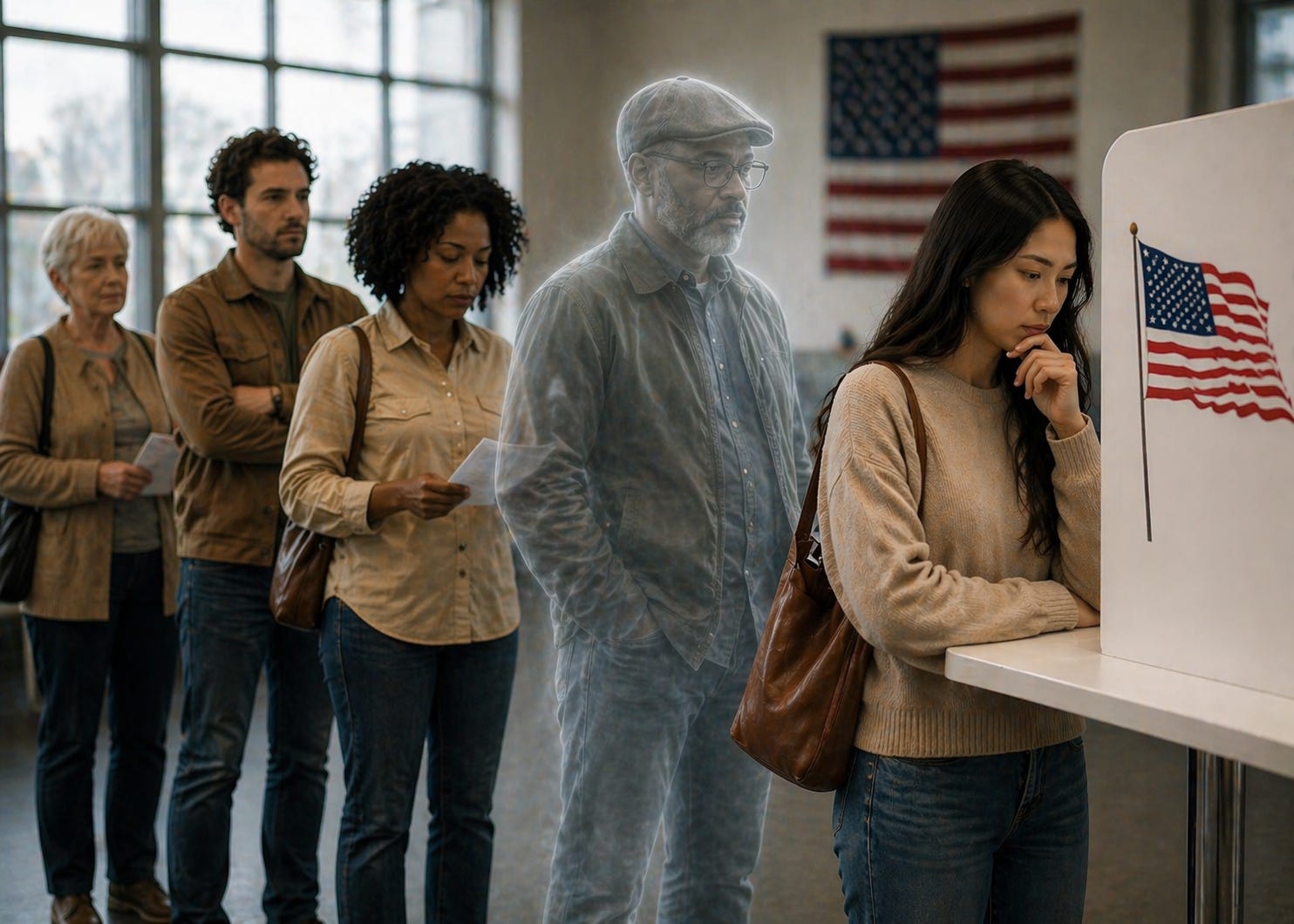
I’ve already explained why chasing the mythical “milquetoast middle” is a spectacular way for Democrats to throw away real votes. Now it’s time to deal with its equally annoying cousin: the independent voter.
You know the type they describe. Independents are pragmatic, centrist, and allergic to ideology. They somehow sit right in between the parties, and Democrats should woo them by watering down every proposal like it’s a homeopathic tincture.
The reality is, this type of independent voter lives almost exclusively in PowerPoints and donor decks.
Independence Is Not Centrism
People hear “independent” and immediately assume we’re talking about a middle-of-the-road centrist. But that’s not reality. It just means they’re unaffiliated.
For many people, “independent” is less a political identity than a factory setting they never bothered to change. Other voters call themselves independent because they don’t feel represented by either party. Sometimes that’s because they’re too liberal for the Democrats or too conservative for Republicans.
Once you strip away the projection and look at what these voters do, the myth collapses immediately. The truth is that most independents lean towards one party or the other. Polling shows that only about 7% of voters refuse to say they lean one way or another.
The Truth About Independent Voters
According to Gallup, 45% of voters call themselves independent. This does not mean nearly half the country is up for grabs every election cycle, though.
From the same Gallup article, independents have historically leaned Democratic. Not perfectly or permanently, but consistently enough to show up on a graph. Include them in the count, and the electorate suddenly looks a lot less like an epic battle over undecided moderates and a lot more like two camps with some loosely affiliated stragglers hanging around the edges.
Democrats are chasing centrist independents who don’t really exist, while ignoring or boring the Democratic-leaning independents who do. It’s a weird kind of political ghost hunting.
This Is Not About Partisanship
The left-right paradigm is bullshit. It oversimplifies the populace's beliefs, arbitrarily assigns issues to one side or the other, and creates a false dichotomy that eliminates nuance from the political conversation.
It also creates the myth of the ideological centrist. If political beliefs exist on a straight line from left to right, there’s a center we can point to on that spectrum and pretend the answers to our problems exist there.
It may be tidy and familiar to do this, but it consistently fails to describe what’s actually happening in the country.
Real voters don’t have neat ideological frameworks. They have a jumble of beliefs, priorities, contradictions, and life experiences that don’t fit onto a neat spectrum. And despite how everything is framed as a 50-50 battle between the two parties, many issues aren’t even close to evenly divided.
Independents Aren’t Looking for Beige
The “win the independents” strategy assumes these voters are spooked by strong positions.
There’s very little evidence for this. Just look at gun control. Background checks are supported by almost 90% of Americans, but somehow, it has become an issue “on the left.” Data for Progress, a progressive organization, found that 71% of independent voters support single-payer healthcare. These are widely popular positions, not fringe ideas.
Independent voters, especially those who lean Democratic, respond to the same things as other voters. Clarity and authenticity in a candidate who sounds like they’ve had an opinion for longer than five minutes is far more appealing than a boring candidate trying to find a middle that doesn’t exist.
The assumption that independents are uniquely fragile in the face of bold ideas says more about the people running campaigns than about voters.
Decades of political science research on issue salience and agenda-setting show that voters aren’t carefully weighing every policy position like judges at a debate tournament. They focus on what feels urgent, rely on mental shortcuts, and make decisions based on what’s top of mind. Which means elections are often less about winning some mythical middle ground and more about controlling which issues voters are thinking about when they cast their ballots.
Independents get frustrated. They get motivated, care about outcomes, and engage when something feels real. Candidates who take clear positions don’t scare them off. They give voters something to respond to and put the right issues top of mind.
Rethinking the Target
Finding the dead center of a spectrum that doesn’t describe anyone was never the point. The real work is identifying what voters care about, saying it plainly, and trusting that clarity is more persuasive than careful hedging.
Democratic-leaning independents aren’t waiting for a candidate who offends no one. They’re waiting for a candidate who makes them feel like something is actually at stake and that the person asking for their vote understands what it is.
Stop hunting ghosts. The voters you need are already there. They’re just hard to excite when you spend all your time chasing shadows in the mist.
Give them a reason to vote for you. Make it real.
RELATED: Democracy has a Gap problem